Bloomfield Township Water Damage Restoration › Macomb County
Water Damage Restoration Across Macomb County, MI
Water pulled out and the structure dried before it has a chance to spread or settle. Bloomfield Township Water Damage Restoration sends a crew into Macomb County by dispatch from the Local Headquarters in Bloomfield Township, Oakland County.
A dispatcher picks up for Macomb County on the same line as every other call. No office sits inside Macomb County yet, so no minute count runs here for it -- ask on the call for a time estimate to your own address.
The job is covered by our written guarantee, which gets a crew back out, not a check.
A County With Many Different Floors to Dry
Macomb County is not one neighbourhood repeated for forty miles. A subdivision built in the last decade sits a short drive from a block that went in before the Second World War, and the two do not flood the same way, fail the same drain, or need the same first call when a basement takes on water. A ranch on a slab behaves nothing like a Cape Cod with a crawl space, and a finished basement with carpet pad behaves nothing like a poured floor with nothing on it but boxes.
The Census Bureau's latest five-year estimate puts Macomb County at 879,853 people. (U.S. Census Bureau ACS 2024 5-year estimates, Macomb County, MI, via Census Reporter) 373,413 housing units sit in the county, and 41.4% of them predate 1970 -- old enough that a plumbing or foundation-drainage failure is a real, not theoretical, risk. (U.S. Census Bureau ACS 2024 5-year estimates (B25034), Macomb County, MI, ZCTA-level tables)
None of that variation changes what matters on the day of a loss: how fast the water is found, how fast it is pulled out, and how well the drying work is written down for whoever pays for it next, a carrier or a homeowner's own pocket. A loss discovered an hour after it starts dries in a single visit, more often than not; a loss discovered three days later, after carpet has already begun to smell, is a different and more expensive job no matter which part of Macomb County it happens in.
A homeowner researching before calling anyone usually wants three questions answered: is this company actually set up to reach my address, does it document the work well enough for an insurance claim, and does it stand behind what it does once the crew leaves. This page answers those three questions for Macomb County specifically, with a source attached to every figure that is not plainly this company's own policy.
This page is built the same way every other page on this site is built: a claim only appears here if a dated, named source backs it. A reader who wants to check any figure can follow the citation next to it rather than take the page's word for it, and a figure that could not be sourced simply does not appear, rather than being estimated to fill space. That rule holds whether the number flatters this company or not.
A county-wide page like this one is written for two different moments: the quiet one, when a homeowner is comparing options before anything has gone wrong, and the urgent one, when water is already moving across a basement floor and the only question left is who picks up the phone. Both readers get the same facts here, just read in a different order depending on which moment they are in.
A skim of the headings below is enough for the urgent reader to find the phone number and the honesty note above; the quiet reader is better served working through the whole page, since the town table, the law, and the drain-authority rules further down answer questions a phone call usually does not have time for.
What a Call From Anywhere in Macomb County Sounds Like
| Step | What happens |
|---|---|
| You call | Say the address and what you can see. The crew gets moving while you are still on the phone, not after a callback. |
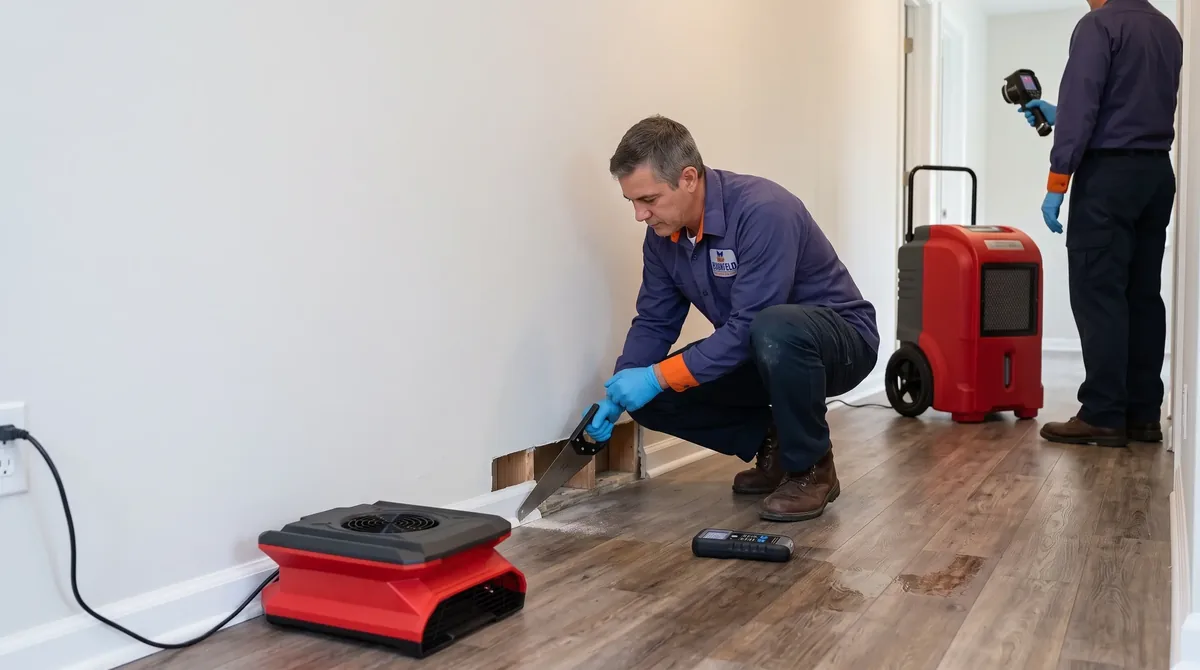
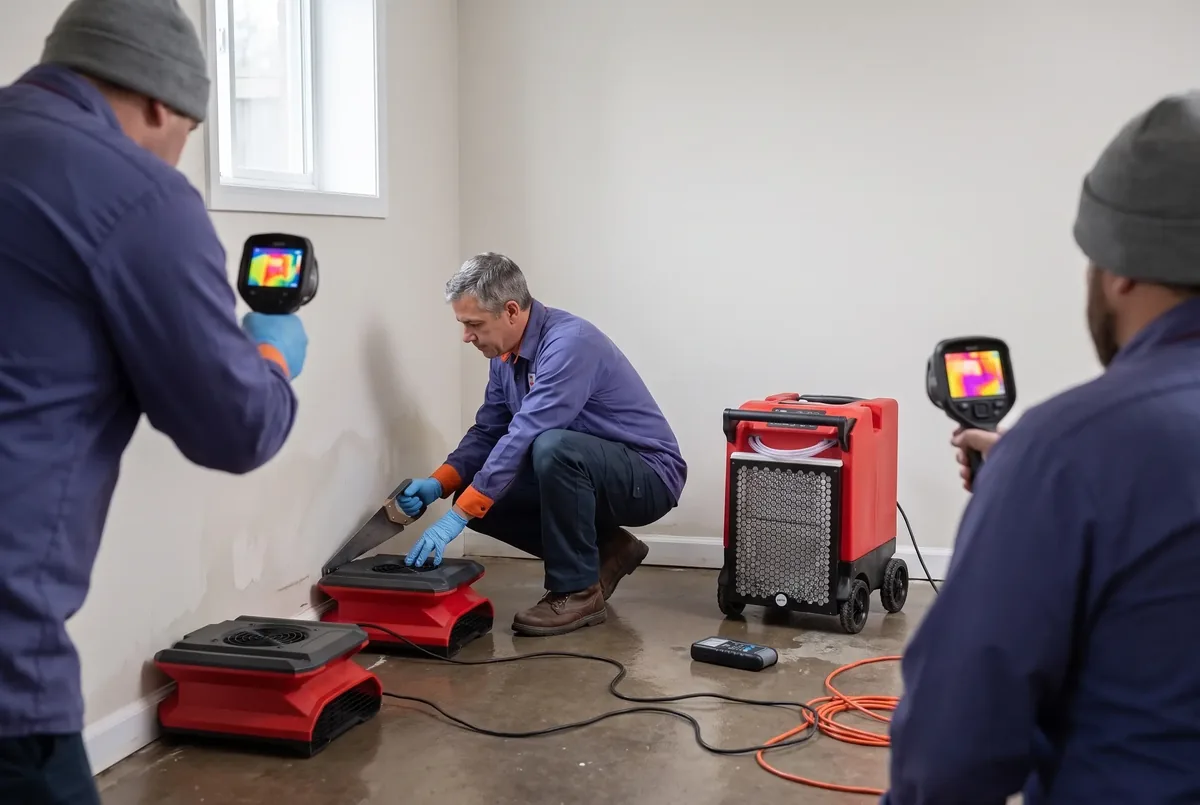
| A crew walks in | Water gets traced back to its source before anything gets moved or torn out, so the right fix gets picked on the first visit. |
| Readings go on paper | Photos and moisture numbers are logged on arrival, dated, for whoever reviews the claim later, a carrier or a homeowner checking the work. |
| Drying runs to a number | Fans and dehumidifiers stay in place until the reading says dry, not until a calendar says so, and the same readings get taken again before the gear comes out. |
Mold is usually the second call, not the first, in a county with this much older housing stock: a basement that sits wet past 48 hours has already crossed the point where drying alone finishes the job, and an older subdivision gives mold more of a head start than a newer build catches in the same storm. Water Damage Restoration and mold remediation both run through the same dispatcher, so a homeowner does not have to figure out which service to ask for before the crew even arrives; that gets sorted on the walk-through.
A sump-pump failure during a storm, a sewer backup after heavy rain, a sudden supply-line break in an older kitchen, and the slow seep that shows up days after a storm has passed are four different calls with four different first steps. Treating them the same way is how a crew misses the actual source of the water instead of only the puddle it left behind.
The on-site estimate is where that first step actually happens: a walk-through of the affected area, a plain explanation of what the crew found, and a written number before anything is signed. Nothing about that estimate costs money, and nothing about it obligates a homeowner to book the job with this company instead of another one.
The Towns on Record
Six towns appear below because each one has a named flood source, a dated event, or a housing-age figure on file, not because a map was divided into even pieces. A town left off this table is not skipped on purpose; it is a town this page has not sourced yet, and the table grows as more of Macomb County gets checked.
| Town | What the record shows | Source |
|---|---|---|
| Sterling Heights | Sterling Heights names the Clinton River, the Red Run Drain, the Plumbrook Drain and Beaver Creek as its flood sources, and its own Office of Engineering will confirm whether a given lot sits in a mapped floodplain. FEMA rates Sterling Heights a Class 7 community under its Community Rating System, which trims 15% off flood-insurance premiums there. | City of Sterling Heights, Flood Services City of Sterling Heights, Flood Insurance |
| Warren | Warren took the worst of an August 11, 2014 storm: 5.2 inches of rain in a few hours, six feet of water inside City Hall, more than 1,000 cars abandoned, and a mayoral state of emergency while the Clinton River gauge at Mount Clemens climbed past 16 feet. Warren alone carries 56,962 housing units with a median build year of 1964, among the older housing stock in the county. | CBS News Detroit Census Reporter (ACS 2024 1-year), Warren, MI |
| St. Clair Shores | St. Clair Shores flooded basements county-wide on August 16, 2016, after just 1.6 inches of rain, because its combined sewer and stormwater system has no direct outlet to Lake St. Clair the way some neighboring cities do. At the foot of Nine Mile Road, the Chapaton Retention Treatment Basin catches combined sewer and storm flow from Eastpointe and most of St. Clair Shores; a two-year, $29 million upgrade took its capacity from 3 million gallons to 17 million. | FOX 2 Detroit Macomb County Public Works, news release (April 2026) |
| Clinton Township | A sewage or storm backup in Clinton Township still goes to the county Public Works Commissioner for anything touching a major county drain; the township's own public-services department only covers its local storm lines, and county road drains answer to the separate Department of Roads. Clinton Township carries 49,724 housing units with a median build year of 1980, and 61.8% of occupied homes there are owner-occupied. | Clinton Township, Stormwater and Drainage Census Reporter (ACS 2024 1-year), Clinton Township, MI |
| Mount Clemens | Since October 1951, the Clinton River Cut-Off Canal has diverted river flow at Mount Clemens into Lake St. Clair as flood relief, though a USGS atlas is careful to note the canal was never built to rule out every future flood. | USGS Hydrologic Atlas HA-59 |
| Fraser | Fraser's stormwater runs through catch basins into county drains, including the Harrington Drain and its tributary the Sweeny Drain, both headed north to the Clinton River at Mount Clemens; the city also recommends a private sewer-lateral inspection every five to ten years. | City of Fraser, Stormwater; City of Fraser, Understanding Your Private Sewer Lateral |
A homeowner outside this table can still call: dispatch from the Local Headquarters still reaches every address in Macomb County, whether or not that specific street has made it onto this page yet. The table is a research aid for a homeowner deciding whether to call, not a claim about where crews have already worked.
Read the comparison guide for Macomb County for a town-by-town look at which companies are actually addressed where, with their own published ratings next to each name.
A town's entry above is a status report, not a sales pitch: a named drain, a dated flood, or a housing-age figure is listed because it is true and sourced, not because it makes the town sound more or less at risk than its neighbor. Two towns can share the same drain authority and still see very different results from the same storm, depending on elevation, age of the sewer main, and how much of the ground nearby has been paved over in the decades since it was built.
A Drain Clock Runs Underneath All of It
Whatever caused the water, a county drain or sewer backup in Macomb County is reported to Macomb County Public Works Office, in writing, within 45 days of discovery , or by calling its hotline at (877) 679-4337. Miss that window and state law can bar recovery outright, separate from anything owed by a homeowner's own insurance carrier, which is why the date a problem was first noticed matters as much as the date a crew showed up.
| What the record shows | Detail | Source |
|---|---|---|
| Retention basin project | At the foot of Nine Mile Road, the Chapaton Retention Treatment Basin catches combined sewer and storm flow from Eastpointe and most of St. Clair Shores; a two-year, $29 million upgrade took its capacity from 3 million gallons to 17 million. | Macomb County Public Works, news release (April 2026) |
| A dated local event | Warren took the worst of an August 11, 2014 storm: 5.2 inches of rain in a few hours, six feet of water inside City Hall, more than 1,000 cars abandoned, and a mayoral state of emergency while the Clinton River gauge at Mount Clemens climbed past 16 feet. | CBS News Detroit |
| A second dated event | St. Clair Shores flooded basements county-wide on August 16, 2016, after just 1.6 inches of rain, because its combined sewer and stormwater system has no direct outlet to Lake St. Clair the way some neighboring cities do. | FOX 2 Detroit |
| A flood-control canal, in use since 1951 | Since October 1951, the Clinton River Cut-Off Canal has diverted river flow at Mount Clemens into Lake St. Clair as flood relief, though a USGS atlas is careful to note the canal was never built to rule out every future flood. | USGS Hydrologic Atlas HA-59 |
Rows like these are not history for its own sake. A county that has already spent real money on drain and retention infrastructure, or that sits on a federal disaster declaration, is a county where a flood claim is a known, documented category of loss, not a rare or suspicious one, and an adjuster reading a file from Macomb County already knows that.
A sewer or storm-drain claim and a homeowners-insurance claim are not the same thing, and they often run at the same time without touching each other. The first goes to the county or township office that owns the pipe; the second goes to whichever company insures the house. A single flood can start both clocks on the same day, which is one more reason the date of discovery gets written down before anything else happens.
Michigan's Insurance Clock Runs the Same Way Here
These four rules apply to a claim filed from Macomb County exactly as they apply anywhere else in the state. None of them is this company's own policy; all four are set by the Michigan Legislature, and none of them depends on which restoration company a homeowner hires.
| Rule | What it requires | Source |
|---|---|---|
| Proof-of-loss notice | Under MCL 500.2006, a Michigan insurer has 30 days from the date you file to put in writing which proof of loss it still needs, unless it has already paid. | Michigan Compiled Laws 500.2006, via Michigan Legislature |
| Payment and interest | The same statute then gives the insurer 60 days to pay, and any undisputed amount paid after that window carries 12% simple interest a year. | Michigan Compiled Laws 500.2006, via Michigan Legislature |
| Appraisal on a disputed amount | When you and the insurer disagree about what a covered loss is worth, MCL 500.2833 lets either side request appraisal in writing, each side names an appraiser within 20 days, and those two pick an umpire who settles the figure. | Michigan Compiled Laws 500.2833, via Michigan Legislature |
| Sewer-backup notice to a government agency | MCL 691.1419, the state's governmental notice rule, asks for written notice to the responsible agency within 45 days of discovering a sewer or drain backup, and a claim against that agency cannot go forward without it. | Michigan Compiled Laws 691.1419, via Michigan Legislature |
Put plainly: an insurer has thirty days to say what it still needs from you in writing, sixty days after that to pay a claim it does not dispute, and owes interest on its own delay past that second window. A disagreement over the dollar amount has its own separate process, appraisal, that either side can start in writing. None of the four clocks waits for a restoration job to finish first.
A homeowner does not need a lawyer to use these rules; writing down the date a claim was filed, keeping the insurer's written requests, and noting when each deadline passes is usually enough. A restoration crew's dated photo and moisture log supports that paper trail, but the homeowner is still the one who files the claim and tracks the calendar.
Being Plain About Where We Are, and Are Not, Yet
Bloomfield Township Water Damage Restoration's Local Headquarters sits at 43996 Woodward Ave, Bloomfield Township, MI 48302, in Bloomfield Township, Oakland County, not inside Macomb County. This page makes no drive-time claim and no county-specific minute promise for Macomb County for that reason; a dispatcher still answers the same 24/7 line, and a crew is still sent, but the clock starts from an address outside the county until a real office is leased inside it. That is a deliberate choice, not an oversight: a page that printed a minute count it could not back up would be worse than a page that says plainly that it cannot, yet.
Nothing about the written guarantee gets thinner for lack of an office; a county with no lease yet still reads the same guarantee page as Bloomfield Township does, and the day an address inside Macomb County becomes real, this page gets rewritten to match it, not sooner.
Set against a competitor's unverified minute claim, the honest version here is plainer but harder to disprove: a dispatcher answers now, a crew gets sent now, and the one thing this page refuses to do is print a number it cannot stand behind.
What Gets Written Down for Your Claim
Three things leave every job in writing, no matter which Macomb County address the call came from: dated photos of the source and the damage before anything is moved, a moisture-reading log taken on arrival and again before equipment comes out, and a plain description of what the crew found and what it did about it. None of that is an opinion about coverage; it is simply the record a homeowner or an adjuster needs to make that decision afterward.
A loss that is well documented on day one is easier to settle than one reconstructed from memory two weeks later, which is part of why the proof-of-loss and payment-interest clocks above move as fast as they do. The paperwork is not a favor; it is the difference between a claim that gets paid on time and one that stalls on a question nobody wrote down the answer to.
The same record also protects a homeowner who is not filing an insurance claim at all, paying out of pocket instead. A dated moisture log is proof the job was actually finished to a dry standard, not just left to air out, and it is the first thing worth asking for if a question ever comes up about whether a space was fully dried.
None of this paperwork replaces a homeowner's own judgment. A dated photo set and a moisture log are evidence a claim can lean on; they are not a substitute for reading the estimate before signing it, or for asking a second company for a comparison number on a job large enough to matter.
Ask for this record up front, not after the fact. A crew that already photographs and logs every job as a matter of habit can say so plainly and immediately; a crew that has to think about whether it does this kind of documentation is telling a homeowner something worth hearing before any work starts, not after.
What Neighbours Say
Bloomfield Township Water Damage Restoration has no Google Business Profile tied to Macomb County on its own; any review count shown elsewhere on this site belongs to the Bloomfield Township listing only and is never borrowed here to describe work in Macomb County. That rule does not change once this page gets more traffic or more calls; a review earned in one city is not restated as proof of work in another.
The seven companies compared in the Macomb County guide linked above each carry their own published Google rating, sourced to that company's own listing, not to this one, and a homeowner comparing options can check any of those ratings directly before picking up the phone.
A published rating is useful for exactly one thing: telling a reader how a company's past customers felt about the finished job. It says nothing about whether that company can reach a given address in Macomb County in a given number of minutes, which is a separate question this page answers honestly elsewhere rather than folding into a star average.
Why the Math Looks Different House to House
Median household income swings hard by ZIP within Macomb County: Mount Clemens' 48043, Warren's 48089 and 48091 sit lowest at roughly $52,000 to $54,000, while the Macomb Township/Ray Township growth corridor tops out near $126,700 at 48042. (U.S. Census Bureau ACS 2024 5-year estimates (B19013, by ZCTA), Macomb County ZCTA tables) That spread matters for how a job actually gets paid for: a documented loss supports an insurance claim or a Macomb County Public Works Office claim either way, and a payment plan covers whatever part neither one picks up.
None of that is a reason to put off the financing conversation until after a crew has already started. Asking about a payment plan before work begins is an ordinary question in a county where the repair bill and the insurance payout do not always land in the same week, not a sign that something has gone wrong with the claim, and a crew on site can usually sketch out the rough shape of a plan before the first wall panel comes down.
Older plumbing and older foundation waterproofing both tend to fail in costlier ways than a newer system does, which is one reason the same square footage of flooding can cost more to put right in one part of Macomb County than in another. A homeowner weighing that cost against the insurance payout the state's 60-day window eventually delivers is exactly who the next section is written for.
Payment plans, drawn out plainly
A payment plan can cover whatever your policy leaves on the table — the crew walks you through it on-site.
Every visit starts with a free estimate.
Financing available
Ask about a plan for the part of the bill insurance won't touch.
Questions Macomb County Callers Ask
Does Bloomfield Township Water Damage Restoration serve Macomb County?
Yes, though the crew is dispatched in from Bloomfield Township rather than from a desk inside Macomb County itself. Either way, the same dispatcher picks up the phone, day or night.
Does insurance pick up any of this in Macomb County?
Possibly, and the insurance claims guide walks through the state-wide rules, the insurer's 30-day window to request proof of loss and its 60-day clock to pay under MCL 500.2006, that govern the answer no matter which county the address sits in.
What's a typical bill for water damage restoration in Macomb County?
There is no flat number, because the on-site estimate is free and the real price follows from three things the crew finds once it arrives: where the water actually came from, which category it falls into, and how many days it sat before anyone called.
Who do I notify about a sewer backup in Macomb County?
Macomb County Public Works Office gets the written notice, inside 45 days of finding the backup (its hotline is (877) 679-4337). That filing runs on its own track, apart from a homeowners-insurance claim and apart from the state's separate 45-day window under MCL 691.1419 for a government-owned drain.
Does the crew leave anything in writing for my adjuster?
Every visit produces dated photos and a moisture-reading log, regardless of whether the address is in Bloomfield Township or Macomb County, and that file is handed over whenever it is asked for.
Does it matter if I wait a day before calling, in Macomb County?
It does. Mold does not wait for a decision to be made, and a basement that has been wet for more than two days is already past the point where fans alone finish the job, which usually turns a same-day fix into a longer one.
Am I locked into booking with Bloomfield Township Water Damage Restoration after the estimate?
Not at all. The on-site estimate costs nothing and carries no obligation, so lining it up against a second company's number before deciding is entirely normal.
When will Macomb County get a staffed office?
There is no date set. The honest answer stays on this page until a lease is signed inside Macomb County, at which point the dispatch wording above is replaced with a real address.
Water Showing Up in Macomb County?
Call (248) 555-0106, 24/7. A dispatcher answers the line, takes the address, and starts a crew moving toward Macomb County before the call even ends. The on-site estimate costs nothing, and the same written guarantee applies whether this is the first call of the night or the fifth.
A dispatcher picks up for Macomb County on the same line as every other call. No office sits inside Macomb County yet, so no minute count runs here for it -- ask on the call for a time estimate to your own address.
Every visit starts with a free estimate.
The job is covered by our written guarantee, which gets a crew back out, not a check.